Deloitte: Back-to-School Spending Holds Steady During Economic Uncertainty
PR Newswire
NEW YORK, July 9, 2026
Surveyed parents approach the season with both intent and restraint, as more than half of respondents expect the economy to worsen this year
NEW YORK, July 9, 2026 /PRNewswire/ --
Key takeaways
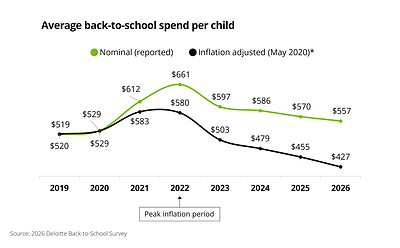
- Back-to-school spending for K-12 students will likely remain steady, estimated to reach a collective $30.4 billion, or approximately $557 per student, based on those surveyed. Adjusted for inflation, families plan to spend 6% less year-over-year.
- Economic uncertainty is high, as 57% of those surveyed expect the economy to worsen in the next six months — the highest level reported in the survey since 2020.
- Value makes the grade: 31% of K-12 parents qualify as hyper value-seekers, adopting four or more cost-saving behaviors. These consumers plan to spend 14% more than other shoppers, suggesting that shopping is less about buying the cheapest item and more about buying intentionally.
- Back-to-school shoppers plan to shift their spending from technology (-16%) to clothing and accessories (+22%).
- Families are pushing back-to-school purchases closer to the start of school, with planned spending expected to peak in late July and early August, a return to pre-pandemic trends.
- Half of parents surveyed worry that their child relies on AI too much in and outside the classroom, while only 33% say their school has AI guidelines. Signaling a potential opportunity for ed-tech and retailers, 13% of parents plan to pay for AI tutoring or camps.
Why this matters
Back-to-school shoppers remain strategic about spending as economic uncertainty remains top of mind. According to the "2026 Deloitte Back-to-School Survey," K-12 parents plan to engage in value-seeking behaviors and push their spending closer to the start of school. Meanwhile, inflation appears to be impacting spending power, and parents are finding ways to navigate it.
Smart spending shapes back-to-school shopping
Consumers continue to approach back-to-school spending with caution. Based on survey respondents' intentions, back-to-school spending is expected to remain flat at $30.4 billion this year. Parents plan to spend $557 per student in grades K-12, down just $13 year over year. However, when adjusted for inflation families plan to spend 6% less year-over-year.
- More than half of surveyed consumers are concerned about the economy: 57% of respondents expect the economy to worsen in the next six months, the highest level reported in the survey since 2020, and 24% of respondents are concerned about making upcoming payments.
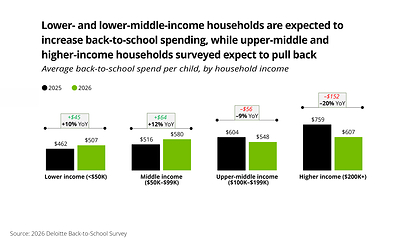
- While lower-income (+10% YoY) and middle-income (+12% YoY) parents expect to spend more due to higher prices, upper-middle-income parents (-9% YoY) and higher-income parents (-20% YoY) say they'll reduce their spending given financial concerns. Reasons vary:
- Eighty percent of lower-income families (those making $50K per year or less) and 71% of middle-income families (those making $50K to 99K annually) cited higher prices as the reason they'll spend more. Sixty-seven percent of upper-middle-income families (those making $100-199K) plan to spend less because they are worried about the economy.
- Sixty-three percent of higher-income families (those making $200K or more) report having less money to spend.
- Spending intent shifts from tech to clothing: Those surveyed plan to spend 22% more on clothing and accessories, an average of $323 per child, but it is also the top category people would cut if budgets get too tight. Spending on technology is expected to decline 16% to an average of $417 per child as parents defer personal device upgrades for their children.
- To make room in their budgets for back-to-school items, half of those surveyed (50%) plan to cut back on other expenses, such as dining out and entertainment.
- Children's preferences shape spending decisions, although slightly less often than last year: 59% of parents surveyed say their children often entice them to spend more, compared to 62% who said the same in 2025. In addition, 45% say their child has a specific must-have item for back-to-school, and 57% say their child influences them to splurge on that item.
Key quote
"While many parents are willing to do all they can to help set their children up for success, financial concerns are leading them to sharpen their budgets. Cautious spending behavior exists across income groups, but value-seekers demonstrate that it's not always about the cost — some consumers are willing to spend if they find value in the purchase. At the same time, there's often a sense of nostalgia about back-to-school that can impact how and when parents spend. Retailers who lean into these dynamics may be more likely to see success throughout the season."
- Natalie Martini, vice chair and U.S. Retail and Consumer Products sector leader, Deloitte
Value-seekers go to the front of the class
As consumers aim to get more out of every dollar, they look to be employing several strategies to help get their children ready for the school year. This includes delaying purchases to later in the season and engaging in value-seeking behaviors. In addition, 68% of those surveyed said they plan to shop for back-to-school items during summer promotional events.
- Families are pushing back-to-school purchases closer to the start of school: 48% of planned spending is expected to occur by the end of July, down from 61% in 2025. An additional 31% of planned back-to-school spending is expected to take place in early August, with average spend that month rising to $173 per child, up from $137 in 2025.
- About one-third (31%) of K-12 parents qualify as hyper value-seekers, meaning they adopt four or more cost-saving behaviors. However, despite their deal-seeking mindset, these consumers are expected to spend 14% more than other shoppers, underscoring that value-seeking can be more about being selective than cutting back.
- K-12 parents surveyed showcase value-seeking behavior in a variety of ways:
- Seventy-one percent say they will switch brands if the preferred brand is too expensive
- Sixty percent plan to shop at more affordable retailers
- Fifty-one percent expect to shop for private labels instead of name brands
- One-quarter (25%) plan to use cashback websites
- Planned spending is consistently higher among parents across all income groups who use a broader set of digital tools in their shopping journey. While non-tech users (20%) plan to spend $381 on average, those planning to use search (30%) plan to spend $494 on average.
- Respondents who use additional tech tools plan to spend more: Search and social media users (21%) plan to spend an average of $531; those who use search, social media, and GenAI (29%) are expected to have the highest spend at $737.
- Most back-to-school purchases are expected to take place in-store rather than online, but online shoppers plan to spend more — an average of $614 compared to $521 for mostly in-store shoppers.
- Mass merchant retailers continue to be the top destination for back-to-school purchases, with 80% of parents planning to shop there. Online retailers, warehouse membership clubs, and department stores are other top destinations.
- Parents plan to shop at four retail formats on average, one less than last year. According to survey respondents, the main reason for spending the most at a retailer remains value for the money.
Key quote
"We see parents approach back-to-school shopping with intent. They tend to be more thoughtful about their spending and value-seeking strategies to help maximize their wallets. Additionally, those who actively use multiple digital tools to research products tend to be more engaged shoppers overall. GenAI users, for example, may spend more time comparing products and filling their carts with more purchases, which can create a further benefit for retailers to lean into the technology."
- Brian McCarthy, principal, Retail Strategy leader, Deloitte Consulting LLP
AI use raises questions about learning and preparedness
Parental concerns are emerging around their children's use of AI, particularly regarding reliance and readiness. Many survey respondents also express uncertainty about school guidance.
- Half (49%) of parents surveyed worry that their child relies on AI too much in and out of the classroom, while only 33% say their school has AI guidelines.
- Signaling gaps in both communication and policy, 38% of those surveyed do not know if their child's school has AI guidelines.
- Signaling a potential opportunity for ed-tech and retailers, 13% of parents plan to pay for AI tutoring or camps.
Deloitte's "Back-to-School" survey was conducted online using an independent research panel between May 22 and May 29, 2026, and surveyed 1,207 parents with at least one child attending school in grades K-12 this fall.
Connect with us on LinkedIn @NatalieMartini and @BrianCMcCarthy.
About Deloitte
Deloitte provides industry-leading audit, consulting, tax, and advisory services to many of the world's most admired brands, including nearly 90% of the Fortune 500® and more than 9,000 U.S.-based private companies. At Deloitte, we strive to live our purpose of making an impact that matters for our people, clients, and communities. We bring together distinct talents, technologies, disciplines, and an ecosystem of alliances to help tackle today's most complex business challenges and drive long-term progress. Deloitte is proud to be part of the largest global professional services network serving our clients in the markets that are most important to them. Bringing more than 180 years of service, our network of member firms spans more than 150 countries and territories. Learn how Deloitte's approximately 470,000 people worldwide connect for impact at www.deloitte.com.
Deloitte refers to one or more of Deloitte Touche Tohmatsu Limited, a UK private company limited by guarantee ("DTTL"), its network of member firms, and their related entities. DTTL and each of its member firms are legally separate and independent entities. DTTL (also referred to as "Deloitte Global") does not provide services to clients. In the United States, Deloitte refers to one or more of the US member firms of DTTL, their related entities that operate using the "Deloitte" name in the United States, and their respective affiliates. Certain services may not be available to attest clients under the rules and regulations of public accounting. Please see www.deloitte.com/about to learn more about our global network of member firms.
 View original content to download multimedia:https://www.prnewswire.com/news-releases/deloitte-back-to-school-spending-holds-steady-during-economic-uncertainty-302821468.html
SOURCE Deloitte