
Custom Shopify Store Design Elements That Convert Browsers to Buyers
Dubai, United Arab Emirates - February 19, 2026 / aicommerce.co /
AICommerce has released a new industry-focused analysis examining how store design decisions influence conversion performance for Shopify-based businesses. The findings address a growing concern among e-commerce operators: stable traffic levels paired with inconsistent or declining conversion rates.
The analysis outlines how structural design elements, rather than visual trends, increasingly determine whether visitors complete purchases. With advertising costs continuing to rise, the report emphasizes that optimizing on-site experience has become a primary lever for sustainable growth.
Addressing Conversion Challenges Facing Shopify Businesses
Across the e-commerce sector, businesses are facing heightened competition and thinner margins. Industry data cited in the analysis indicates that more than 70 percent of shoppers leave online stores without completing a purchase, often due to confusion, lack of trust signals, or friction during checkout.
AICommerce’s research highlights how foundational decisions made during a Shopify store setup service directly impact long-term performance. When navigation, product hierarchy, and checkout structure are designed with user behavior in mind, conversion consistency improves without requiring additional traffic spend.
Why Traffic Alone No Longer Solves Revenue Problems
The report notes that many businesses attempt to solve conversion issues by increasing ad budgets. However, this approach often amplifies existing inefficiencies rather than resolving them. Structural clarity now plays a more decisive role in determining return on investment, particularly for brands operating in crowded markets.
The Shift Toward Conversion-First Store Design
Rather than focusing on surface-level aesthetics, the analysis emphasizes custom Shopify store design as a strategic discipline. This approach prioritizes clarity, predictable user flow, and reduced cognitive load over visual complexity.
AICommerce by Peter Szabo explains that conversion-focused environments guide visitors through a logical decision path, minimizing hesitation points. This framework applies equally to new builds and businesses choosing to buy ready-made Shopify store options to accelerate market entry.
Simplicity as a Competitive Advantage
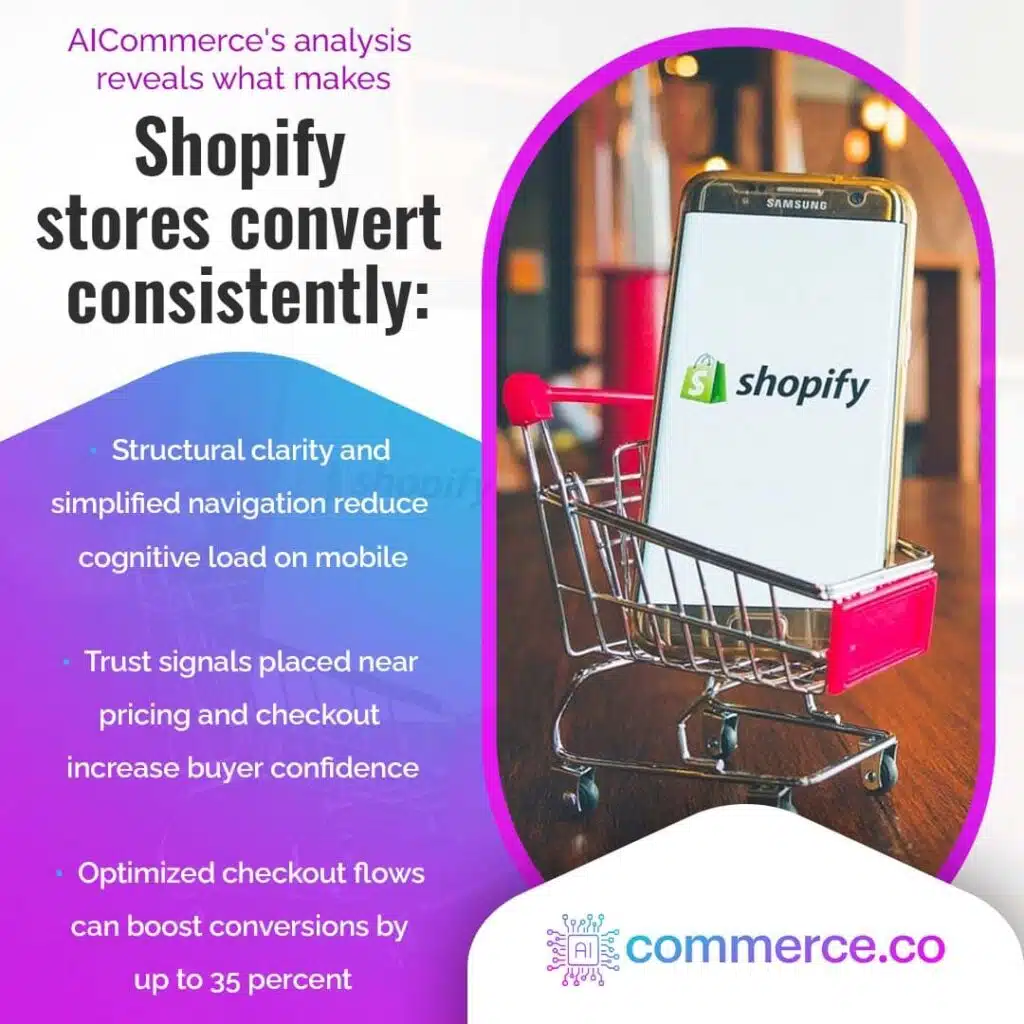
Mobile traffic now represents more than 70 percent of e-commerce sessions. The analysis shows that overly complex layouts perform poorly on smaller screens, where attention is limited. Simpler structures consistently outperform visually dense designs when measured against engagement and conversion metrics.
Trust Architecture and Buyer Confidence
Trust remains a primary factor influencing purchase decisions. The analysis references industry research showing that approximately 19 percent of cart abandonments stem from payment security concerns, while 17 percent result from unclear return or fulfillment policies.
AICommerce outlines how trust elements placed near pricing, calls to action, and checkout stages are more effective than generic disclosures placed in footers or secondary pages. These insights are particularly relevant for businesses evaluating a pre-built Shopify store for sale, where trust signals may require adjustment before scaling traffic.
Social Proof Placement and Context
The report also discusses how testimonials and reviews influence buyer confidence when placed contextually. Rather than serving as decorative elements, they function as reassurance tools when aligned with specific buyer concerns.
Checkout Optimization as a Revenue Lever
The checkout structure receives significant attention in the analysis due to its outsized impact on revenue. Industry benchmarks cited indicate that simplifying checkout fields can increase conversions by up to 35 percent.
For businesses operating or acquiring a pre-built Shopify store for sale, the report stresses the importance of auditing checkout flow early. Even small changes to form length, payment options, and visual consistency can materially affect outcomes.
Reducing Friction at the Final Decision Point
The findings reinforce that checkout is not merely a technical step, but a psychological one. Visual continuity between product pages and checkout reinforces trust, while sudden design shifts introduce doubt.
Supporting Scale Through System-Based Design
As businesses grow, design decisions must support delegation and operational efficiency. The analysis explains how modular layouts and consistent frameworks reduce friction when teams expand or processes are outsourced.
This becomes particularly important during Shopify store migration services, where poorly planned transitions can disrupt conversion performance. AICommerce notes that maintaining design continuity during migrations protects trust signals and minimizes revenue volatility.
Aligning Design With Traffic Strategy
The report also addresses the relationship between advertising and on-site experience. When traffic sources and landing environments are misaligned, conversion rates suffer regardless of ad quality.
AICommerce outlines how its agency services integrate store structure, traffic execution, and system licensing into a single operating framework. This approach reduces fragmentation and supports scalability across one or multiple advertising platforms.
Industry Implications for E-Commerce Operators
The analysis suggests that conversion optimization will continue to outweigh traffic acquisition as a growth lever in the coming years. Rising ad costs make efficiency a necessity rather than an advantage.
These insights are especially relevant for businesses exploring turnkey Shopify ecommerce solutions or working with the best Shopify developers for hire, as execution quality increasingly determines profitability.
About AICommerce
AICommerce is an e-commerce education and agency firm that helps entrepreneurs build scalable online businesses through structured Shopify store design service, traffic execution, and system-based frameworks. The company provides services including store creation, optimization, traffic management, and operational system licensing. To learn more about Peter Szabo and AICommerce’s services, contact them today at support@aicommerce.co.

Contact Information:
aicommerce.co
IFZA Business Park, Dubai Digital Park, Dubai Silicon Oasis
Dubai, 56411-001
United Arab Emirates
Peter Szabo
(424) 521-3939
https://aicommerce.co
Original Source: https://aicommerce.co/custom-shopify-store-design-elements-that-convert-browsers-to-buyers/