New York, NY, May 28, 2026 (GLOBE NEWSWIRE) -- Compounded medications are not FDA-approved finished drug products. Keeps TRT connects patients with licensed healthcare providers who independently evaluate eligibility for treatment. Always consult a qualified healthcare professional before starting, changing, or stopping any prescription treatment. This content contains affiliate links. If a purchase is made through links in this release, a commission may be earned at no additional cost to the purchaser.
Quick Answer: Keeps TRT is designed as a lab-guided online testosterone therapy platform where licensed clinicians evaluate eligibility before prescribing medication when medically appropriate. The platform operates at jointitan.com through Titan Meds Platform LLC. Treatment options include injectable TRT, oral TRT, and enclomiphene - used off-label for testosterone therapy and not FDA-approved for that indication. All medications are compounded and have not been reviewed or approved by the FDA for quality, safety, or effectiveness per the brand's own published disclosure. The process is built around lab testing at partner facilities, virtual clinician review, and prescription fulfillment where medically appropriate. Entry starts at a published $49 covering the initial lab panel and clinician consultation. Month-to-month billing. No long-term contract. Current pricing and availability are confirmed at jointitan.com.
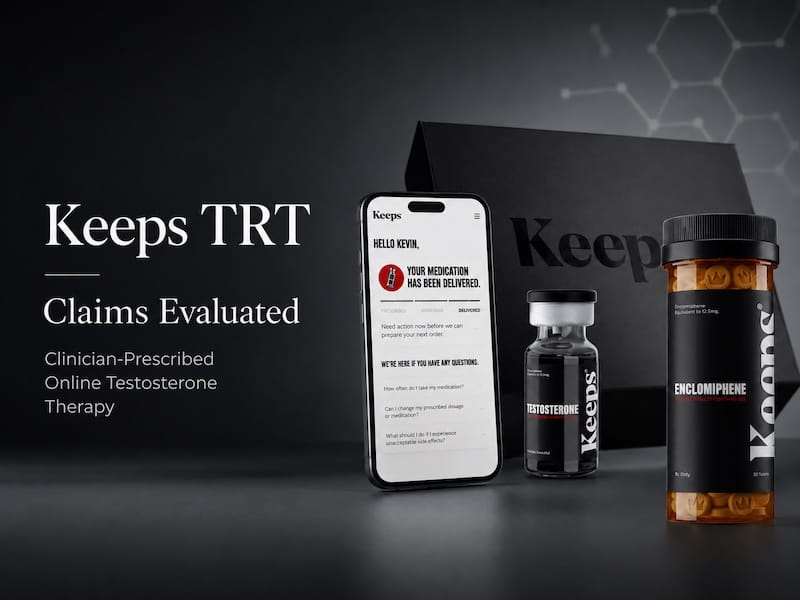
Keeps TRT at a Glance
Keeps TRT is a telehealth-based testosterone replacement therapy platform built around online lab testing, licensed clinician consultation, and prescription decisioning where medically appropriate. The platform operates at jointitan.com through Titan Meds Platform LLC, a Delaware limited liability company. Clinical care is delivered through a network of licensed professional medical entities across multiple states. Entry is published at $49. Monthly membership is designed to cover lab work, medication, licensed clinician access, and shipping. Month-to-month billing. No long-term contract required.
View the current Keeps TRT offer (official Keeps TRT page)
What Is Testosterone Replacement Therapy and How Does the Online Pathway Work
Testosterone is the primary male sex hormone responsible for energy regulation, muscle maintenance, bone density, cognitive performance, and sexual function. Levels begin declining in most men as early as their 30s - and that decline doesn't happen on a neat schedule. Some men notice it at 35. Some don't until their 50s. What matters clinically isn't the decline itself but whether it drops low enough, and correlates with enough symptoms, to warrant a licensed clinician's evaluation.
Testosterone replacement therapy is designed to support clinically appropriate hormone replacement when a licensed clinician determines treatment is medically appropriate after reviewing labs, symptoms, health history, and contraindications. The telehealth model is built around the same clinical framework as traditional endocrinology: lab confirmation of testosterone levels, clinician evaluation of symptoms and health history, a prescription decision if appropriate, and ongoing monitoring through renewal labs. What the telehealth delivery model removes is the need for in-person clinic visits - not the oversight.
Search interest around terms including Keeps TRT claims evaluated, clinician-prescribed testosterone replacement therapy medication online, Keeps TRT compounded medication, Keeps TRT FDA status, and Keeps TRT lab testing reflects the verification process men run before making any decision about hormone therapy. The sections below address each of those questions directly.
Buyer takeaway: Keeps TRT is designed for men with low testosterone who want a fully online, lab-confirmed, clinician-guided pathway. The platform requires labs before every prescription - that structure is designed to support clinician monitoring throughout the treatment cycle. Current eligibility, pricing, and state availability are confirmed at jointitan.com.
How Keeps TRT Works: Lab Testing, Clinician Review, and Prescription Decisioning
Quick answer: Keeps TRT is built around a three-stage process: lab testing at a partner facility, a virtual clinician appointment to review results and evaluate eligibility, and prescription fulfillment if medically appropriate. The renewal cycle requires updated labs before every refill. Labs are covered by the membership fee. The process is designed to maintain clinician oversight at every stage of treatment - not just at the start.
After enrollment at the $49 entry price, a lab order is generated in the member portal and sent by email. Labs are completed at an assigned partner facility - LabCorp, Quest Diagnostics, or BioReference - based on location. No appointment is needed at the facility; the lab order and a valid photo ID are sufficient. Lab costs are covered by the membership fee. An at-home lab kit is available when no partner facility is within 50 miles, sent based on geographic need rather than preference.
The 11-biomarker panel is designed to give clinicians a full picture before making a prescription decision. It covers Free Testosterone, FSH, LH, Estradiol, AST, ALT, Prolactin, PSA, Hematocrit, SHBG, and Albumin - markers that support evaluation of testosterone levels, liver function, prostate health indicators, red blood cell levels, and hormone binding. That broader panel supports clinician monitoring at each renewal.
Once results are processed, a virtual clinician appointment is scheduled through a secure, HIPAA-compliant platform. The clinician reviews lab results alongside reported symptoms and treatment goals. A prescription is written if treatment is clinically appropriate. The clinician may decline to prescribe or recommend in-person evaluation if the telehealth model is not suitable for the individual's situation - that decision rests entirely with the licensed provider. The Telehealth Consent specifies that the assigned provider may be a nurse practitioner or physician assistant rather than a physician.
The first shipment includes an 8-week supply of medication. Injectable TRT shipments include syringes and alcohol pads. Processing takes approximately 2 business days after the prescription is written; delivery is typically 3-5 business days after that. Shipping is free and packaging is discreet.
The renewal cycle begins 28 days after the prescription is written. The Titan Renewal form is mandatory - labs and the follow-up clinician appointment cannot proceed without it. After the form is submitted, a new lab order is generated, labs are completed at the assigned partner facility, a follow-up appointment confirms the treatment plan, and a 12-week supply is shipped with each renewal. Labs are required before every prescription refill or dosage change until the clinician advises otherwise.
Buyer takeaway: The lab requirement before every renewal is designed to help clinicians monitor clinically relevant changes, including hematocrit, blood pressure considerations, and PSA-related signals. Keeps TRT's published policy is straightforward: no labs, no prescription. That requirement is one of the most important process details to verify when evaluating any online TRT platform.
What Treatment Options Does Keeps TRT Offer
Quick answer: Keeps TRT offers three primary treatment pathways - injectable TRT, oral TRT, and enclomiphene (off-label, not FDA-approved for testosterone therapy) - plus anastrozole as a clinician-prescribed add-on when estradiol management is indicated. All treatment decisions are determined by the assigned licensed clinician based on lab results, symptoms, and health history. Enclomiphene is the platform's option for men with fertility considerations who want to support testosterone production without replacing it directly.
Injectable Testosterone. Injectable TRT is designed for subcutaneous administration in most cases - under the skin rather than intramuscularly - on a weekly or biweekly schedule per the clinician's prescription. The member portal includes video guidance on injection technique. Injection site rotation is built into the protocol to prevent tissue damage and maintain absorption effectiveness over time.
Oral TRT. Oral testosterone is delivered via oral dissolvable tablets absorbed through the cheek and gums, taken once or twice daily per clinician prescription. The oral pathway is designed for men who want the structure of a daily-pill format rather than injections.
Enclomiphene (Off-Label). Enclomiphene is not FDA-approved for testosterone therapy and is prescribed off-label through this platform. Enclomiphene works as an estrogen receptor antagonist in the hypothalamus, designed to stimulate GnRH, LH, and FSH secretion - supporting the body's own testosterone production rather than replacing it directly. The platform offers enclomiphene for men with fertility goals who want to support testosterone production without replacing it, men who want to avoid testosterone products including injections, and men with secondary hypogonadism not related to elevated prolactin levels. Published clinical protocols recommend an MRI to evaluate for pituitary or hypothalamic pathology before starting enclomiphene. Men with fertility goals should discuss testosterone therapy, enclomiphene, and relevant risks with the assigned clinician before treatment begins. Contraindications include liver disease, hepatic dysfunction, pituitary or hypothalamic tumors, and hypersensitivity to enclomiphene or related compounds including clomiphene.
Anastrozole (Clinician-Prescribed Add-On). Anastrozole is an aromatase inhibitor designed to reduce elevated estradiol levels when estradiol rises above the clinician's target range during testosterone therapy and associated symptoms are present. It is co-administered with testosterone when clinically indicated based on lab results and symptom review.
Buyer takeaway: Three pathways, one targeted add-on, all gated by clinician review of lab results. Understanding enclomiphene's off-label status and contraindication profile before the clinician appointment can help patients prepare more specific questions for the assigned clinician.
What the Published Evidence Shows on Testosterone Therapy
The evidence base for testosterone replacement therapy in men with diagnosed hypogonadism - laboratory-confirmed testosterone deficiency with associated symptoms - is well-established. The Testosterone Trials (TTrials), a coordinated set of placebo-controlled studies, found improvements in certain measured outcomes including bone density, hemoglobin, and hormone-related wellness parameters with testosterone therapy. These findings support TRT as an appropriate intervention for men with clinically confirmed low testosterone and correlating symptoms.
The National Center for Complementary and Integrative Health, part of the National Institutes of Health, has noted that evidence for testosterone therapy in men without a clinical diagnosis of hypogonadism - men whose testosterone falls within broad reference ranges despite experiencing symptoms - is less consistent, and that cardiovascular risk data in this population requires ongoing evaluation. The American Urological Association and the Endocrine Society distinguish between treating confirmed hypogonadism and treating age-related testosterone decline in men without a diagnosable underlying condition. Reasonable physicians can and do disagree about the appropriate threshold for intervention and the magnitude of benefit at varying testosterone levels.
The FDA issued class-wide labeling changes for all testosterone products on February 28, 2025, based on the TRAVERSE trial and required postmarket ambulatory blood pressure monitoring studies. The updated labeling includes a new warning that testosterone products are associated with increased blood pressure - a finding that applies across all delivery methods and formulations. The FDA retained its limitation-of-use statement specifying that testosterone is approved for men with a confirmed underlying medical condition causing testosterone deficiency, not for age-related decline alone.
Keeps TRT is built around a symptom-based, personalized evaluation model where clinicians review both lab values and the individual's symptom picture rather than relying on a single threshold number. That approach reflects how some hormone-optimization-focused clinicians evaluate this category and may differ from general practice framing of the same lab values. Keeps TRT's medications are compounded and have not been FDA-reviewed for quality, safety, or effectiveness. The clinical context established by the FDA's 2025 labeling update - blood pressure monitoring, contraindication screening - is a relevant clinical consideration for testosterone therapy regardless of formulation type.
Buyer takeaway: The evidence base for TRT in clinically confirmed hypogonadism is more established than the evidence base for symptom-based prescribing in normal-range or borderline cases. The picture in normal-range, symptom-based cases is more contested - and that normal-range or borderline category is a common consumer search concern in the online TRT market. The clinician appointment is the appropriate place to evaluate where an individual's specific lab values and symptoms fall within that evidence landscape. Blood pressure monitoring before and during testosterone therapy is a clinically relevant consideration regardless of where that conversation happens.
Keeps TRT Pricing, Billing, and What Is Included
Keeps TRT materials reference a $49 starting point for labs and clinician consultation. That figure is consistent across reviewed brand materials as of May 2026. The platform also displays a promotional offer of $100 off labs and clinician consultation on the enrollment lander - current availability of this promotion is confirmed at checkout.
Monthly pricing beyond the initial entry point requires direct verification at jointitan.com before enrollment, because two different pricing figures appear across the brand's own published materials. One section lists injectable TRT at $159 per month, oral TRT at $199 per month, and enclomiphene at $199 per month. A separate section lists injectable and oral TRT at $200 per month and enclomiphene at $250 per month. Both figures appear in brand materials; current monthly pricing, medication-specific costs, promotional availability, billing cadence, and cancellation terms are confirmed through the official Keeps TRT website before enrollment.
Monthly billing is charged every 28 days on a recurring basis from the day of enrollment. Medication ships in multi-month supplies - 8-week supply on the first shipment, 12-week supply on renewal - while the billing cycle runs monthly to cover labs, clinician access, and ongoing support alongside the medication itself.
The monthly membership is designed to cover: lab work, medication including syringes and alcohol pads for injectable TRT, licensed clinician access through the member portal, shipping, and customer support 7 days a week. Keeps TRT operates as a cash-pay membership model, with current payment terms confirmed before enrollment. Applicable state and local taxes are calculated separately at checkout.
Cancellation is available at any time by emailing support@jointitan.com. No further charges occur after cancellation is confirmed. There is no long-term contract and no minimum commitment. Charges already processed are non-refundable. Once a prescription for a given billing period is written and in fulfillment by a pharmacy, no refund is issued for that period. The timing of a cancellation request relative to when the prescription is written in each cycle determines whether the current month's charge is refundable.
View the current Keeps TRT offer (official Keeps TRT page)
Safety and Monitoring: What Every Man Should Understand Before Starting TRT
Testosterone therapy is a prescription medical treatment that requires clinician evaluation, monitoring, and follow-up. It involves a Schedule III controlled substance, a real contraindication profile, and ongoing monitoring requirements that exist for good reason. These requirements are why lab testing, accurate medical history disclosure, and clinician monitoring are central to how this platform is structured.
Common side effects of testosterone therapy include acne, oily skin, increased hair growth, gynecomastia via aromatization, mood changes, and hot flashes or night sweats. Cardiovascular effects may include increased blood pressure - the subject of the FDA's February 28, 2025 class-wide labeling update. Hematologic effects may include polycythemia - elevated hematocrit - monitored through the required renewal lab panel. Hepatic effects including liver dysfunction are possible. Reproductive effects include reduced sperm production, testicular atrophy, and changes in men's general vitality. Additional effects include poor sleep, sleep apnea worsening, edema, and nipple sensitivity.
Contraindications for testosterone therapy include: known or suspected prostate cancer or male breast cancer; hypersensitivity to testosterone or any component of the formulation; serious cardiac, hepatic, or renal disease; elevated hematocrit above 54%; and untreated or uncontrolled sleep apnea.
Testosterone therapy suppresses natural sperm production through the negative feedback loop: increased testosterone signals the hypothalamus and pituitary to reduce LH and FSH production, both critical for spermatogenesis. Testosterone therapy may impair fertility. Men with fertility goals should discuss this with the assigned clinician before any prescription is written - ideally during the intake process, before treatment begins.
Drug interaction considerations for this category include: anticoagulants including warfarin may require dose adjustments because testosterone can affect clotting factor metabolism; insulin and oral diabetes medications may require adjustment because testosterone can affect glucose metabolism; and medications affecting CYP3A4 and CYP1A2 pathways may interact with anastrozole if that add-on is prescribed. Complete medication and supplement disclosure during the clinician intake and consultation is essential.
The PSA monitoring requirement in every renewal panel is not administrative overhead - it reflects that testosterone therapy can affect prostate tissue, and that significant or rapid PSA rises during therapy warrant further investigation. That's one of the most important reasons the 11-marker panel is required before every refill, not just at the start.
Buyer takeaway: The PSA monitoring, fertility disclosure, blood pressure warning, and enclomiphene off-label status are documented in Keeps TRT materials and should be reviewed before the clinician appointment. Reviewing those materials at jointitan.com before that appointment is the step that makes the conversation productive rather than reactive.
Telehealth Prescribing Rules, State Availability, and the 2026 Regulatory Context
Testosterone is a Schedule III controlled substance under federal law. Online prescribing of Schedule III substances via telehealth exists within a specific regulatory framework - and in 2026, that framework is still evolving.
Current DEA and HHS telemedicine prescribing flexibilities allow licensed clinicians to prescribe testosterone via telehealth without a mandatory prior in-person evaluation through December 31, 2026. Permanent rules governing telehealth prescribing of controlled substances have not been finalized as of May 2026. Whether permanent rules will require in-person evaluation, set documentation thresholds, or impose other conditions remains subject to regulatory development at both the federal and state levels.
State availability adds another layer. Keeps TRT is available in all 50 states plus the District of Columbia per brand materials, but TRT availability via telehealth varies by state in accordance with applicable state telemedicine laws. Current state availability and prescribing requirements are confirmed through the official Keeps TRT website before enrollment. The support team at support@jointitan.com or +1 (551) 209-3340 can confirm current platform availability and enrollment requirements for a specific state.
Men coming from another TRT provider who want to continue an existing protocol through Keeps TRT require fresh labs through a partner facility regardless of prior prescription documentation. A PDF of prior prescription documentation - including medication name, dose, frequency, member name and date of birth, date the RX was filled or written, and date of first injection on the prior medication - allows the clinician to consider the prior protocol during the consultation. New labs remain mandatory.
Buyer takeaway: The telehealth prescribing framework that makes Keeps TRT's model possible runs through the end of 2026 under current flexibilities. Whether permanent rules require changes after that point is not settled. Understanding that context is useful before enrolling - not because it changes what the platform offers today, but because it's the kind of regulatory fact that belongs in any honest 2026 evaluation of this category.
Contact Information
Keeps TRT is operated by Titan Meds Platform LLC. The following contact information is confirmed from brand published materials as of May 2026.
General support: support@jointitan.com
Order support: orders@jointitan.com
Billing support: billing@jointitan.com
Phone: +1 (551) 209-3340
Support hours: Daily, 8am-8pm EST
Platform portal: jointitan.com
View the current Keeps TRT offer (official Keeps TRT page)
Frequently Asked Questions
What is Keeps TRT?
Keeps TRT is a clinician-prescribed online testosterone replacement therapy platform designed as a lab-guided care pathway where licensed clinicians evaluate eligibility before prescribing medication when medically appropriate. The platform operates at jointitan.com through Titan Meds Platform LLC, a Delaware limited liability company. Clinical care is delivered by licensed professionals associated with a network of professional medical entities named in the brand's Terms and Conditions, including OpenLoop Healthcare Partners variants, Rezilient OLH entities, Reliant MD Medical Associates PLLC, and JMP Medical entities across multiple states. Titan Meds Platform LLC manages administrative and logistical functions; prescribing decisions are made exclusively by the licensed clinicians associated with those professional medical entities.
Is Keeps TRT a supplement?
No. Keeps TRT is a prescription telehealth service that provides clinician-prescribed testosterone medications through a licensed care pathway - not a dietary supplement. Medications prescribed through this platform are compounded and require a valid prescription from a licensed clinician following lab testing and clinical evaluation. Testosterone is a Schedule III controlled substance under federal law. Access to prescription medication through this platform requires lab testing, licensed provider review, and a formal prescription decision. Men who are looking for an over-the-counter testosterone supplement are looking at a different product category entirely - and one with a very different regulatory and clinical profile.
Are Keeps TRT medications FDA-approved?
No. Medications prescribed through Keeps-affiliated providers are compounded. Per the brand's own footer disclosure at jointitan.com: medications prescribed through Keeps-affiliated providers have not been reviewed or approved by the FDA for quality, safety, or effectiveness. Compounded medications are legally prescribed and widely used in telehealth hormone therapy programs, but they are not subject to the same pre-market quality, safety, and efficacy review that FDA-approved pharmaceutical products undergo. The FDA's class-wide testosterone labeling update of February 28, 2025 applies to FDA-approved formulations; the clinical context it establishes - blood pressure monitoring, contraindication screening - applies to testosterone therapy regardless of formulation type. Men who specifically require FDA-approved testosterone formulations should confirm available options directly with any platform before enrolling.
What treatment options are available through Keeps TRT?
Keeps TRT offers three primary treatment pathways: injectable testosterone (administered subcutaneously in most cases on a weekly or biweekly schedule), oral testosterone (oral dissolvable tablets absorbed through the cheek and gums once or twice daily), and enclomiphene (an off-label option not FDA-approved for testosterone therapy, designed to stimulate the body's own testosterone production rather than replacing it directly). Anastrozole is available as a clinician-prescribed add-on when estradiol management is indicated based on lab results and symptoms. All treatment decisions are determined by the assigned licensed clinician based on the individual's lab panel, symptoms, health history, and eligibility. No treatment type is guaranteed in advance of that evaluation.
What is enclomiphene?
Enclomiphene is an oral medication designed to stimulate endogenous testosterone production by affecting hormonal signaling pathways - specifically by acting as an estrogen receptor antagonist in the hypothalamus to increase GnRH, LH, and FSH secretion. This mechanism is intended to support the body's own testosterone production rather than replacing testosterone from an external source. Enclomiphene is not FDA-approved for testosterone therapy and is prescribed off-label through this platform. Long-term data on enclomiphene use is limited per published clinical literature. Men with fertility goals should discuss testosterone therapy, enclomiphene, and relevant risks with the assigned clinician before treatment begins. Contraindications include liver disease, hepatic dysfunction, pituitary or hypothalamic tumors, and hypersensitivity to enclomiphene or related compounds.
Does Keeps TRT require lab testing?
Yes - at every stage, not just at enrollment. The 11-biomarker panel is required before the first prescription and before every prescription refill or dosage change. The Titan Renewal form must be completed 28 days after the prescription is written before a new lab order is generated. The follow-up clinician appointment cannot proceed until labs are complete. Lab costs are covered by the monthly membership fee. Labs are completed at an assigned partner facility - LabCorp, Quest Diagnostics, or BioReference - based on location. An at-home kit is available only when no partner facility is within 50 miles, not as a default option. The policy is explicit: no labs, no prescription.
Can testosterone therapy affect fertility?
Yes, potentially significantly. Testosterone replacement therapy suppresses natural sperm production through the negative feedback loop: increased testosterone signals the hypothalamus and pituitary to reduce LH and FSH production, both of which are critical for spermatogenesis. Testosterone therapy may impair fertility. The effect can persist for a period after discontinuation, and individual recovery of spermatogenesis varies. Men who want to preserve fertility should discuss this before treatment begins - not after. Enclomiphene is designed to support testosterone production rather than replacing it directly, which is why the platform offers it for men with fertility considerations, though men with fertility goals should discuss all relevant risks with the assigned clinician before any prescription is written.
What did the FDA change about testosterone labeling in 2025?
On February 28, 2025, the FDA issued class-wide labeling changes for all testosterone products based on the TRAVERSE trial and required postmarket ambulatory blood pressure monitoring studies. The updated labeling includes a new warning that testosterone products are associated with increased blood pressure - applying across all delivery methods and formulations. The FDA removed the prior boxed warning about major adverse cardiovascular outcomes that had been on testosterone labels since 2015, replacing it with the more specific blood pressure warning based on the postmarket data. The FDA retained its limitation-of-use statement that testosterone is approved for men with a confirmed underlying medical condition causing testosterone deficiency, not for age-related decline alone. This labeling update applies to FDA-approved formulations; blood pressure monitoring before and during testosterone therapy is a clinically relevant consideration regardless of formulation type.
Is online TRT prescribing allowed in 2026?
Yes, under current regulatory conditions. Current DEA and HHS telemedicine prescribing flexibilities allow licensed clinicians to prescribe testosterone via telehealth without a mandatory prior in-person evaluation through December 31, 2026. These flexibilities are in place while permanent rules for telehealth prescribing of Schedule III controlled substances are finalized. Permanent regulations governing telehealth testosterone prescribing had not been published as of May 2026. State availability varies in accordance with applicable state telemedicine laws - not every state permits telehealth prescribing for testosterone under the same conditions. Current state-specific availability and prescribing requirements are confirmed directly through the Keeps TRT platform before enrolling.
How much does Keeps TRT cost?
Keeps TRT materials reference a $49 starting point for the initial lab panel and clinician consultation. The platform also displays a promotional offer of $100 off labs and clinician consultation on the enrollment lander as of May 2026; current availability is confirmed at checkout. Monthly pricing beyond the entry point requires direct verification at jointitan.com before enrollment, because two different pricing figures appear across the brand's own published materials - one section lists injectable TRT at $159 per month, oral TRT at $199 per month, and enclomiphene at $199 per month, while another section lists injectable and oral TRT at $200 per month and enclomiphene at $250 per month. Current monthly pricing, medication-specific costs, promotional availability, billing cadence, and cancellation terms are confirmed through the official Keeps TRT website before enrollment. Keeps TRT operates as a cash-pay membership model; applicable taxes are calculated separately at checkout.
Summary
Keeps TRT is designed as a lab-guided online testosterone therapy platform where licensed clinicians evaluate eligibility before prescribing medication when medically appropriate. The platform is operated by Titan Meds Platform LLC at jointitan.com. Treatment options include injectable TRT, oral TRT, and enclomiphene - not FDA-approved for testosterone therapy and prescribed off-label - plus anastrozole as a clinician-prescribed add-on. Medications are compounded and have not been reviewed or approved by the FDA for quality, safety, or effectiveness per the brand's own published disclosure.
The process is built around lab testing, virtual clinician review, prescription decisioning where appropriate, and renewal monitoring with labs required before every refill. Entry starts at a published $49. Monthly pricing is confirmed at jointitan.com. Month-to-month billing. No long-term contract. Cancellation available at any time by email.
The February 28, 2025 FDA class-wide testosterone labeling update - adding a blood pressure warning across all testosterone products based on the TRAVERSE trial - and the current DEA and HHS telemedicine prescribing flexibilities running through December 31, 2026 are relevant regulatory context for any 2026 evaluation of online testosterone therapy. Both are worth understanding before enrolling in any platform in this category.
View the current Keeps TRT offer (official Keeps TRT page)
Additional Keeps Coverage
Additional previously published Keeps coverage is available below.
These statements have not been evaluated by the Food and Drug Administration. Keeps TRT connects patients with licensed healthcare providers who independently evaluate eligibility for treatment. Compounded medications are not FDA-approved finished drug products and have not been reviewed or approved by the FDA for quality, safety, or effectiveness. Testosterone replacement therapy involves a Schedule III controlled substance under federal law. Testosterone therapy may impair fertility. Always consult a qualified healthcare professional before starting, changing, or stopping any prescription treatment. Individual results vary.
Testosterone therapy may not be appropriate for all patients. Potential risks include increased blood pressure, polycythemia, hepatic effects, fertility impairment, testicular atrophy, sleep apnea worsening, mood changes, acne, and fluid retention. Contraindications include known or suspected prostate cancer or male breast cancer, serious cardiac, hepatic or renal disease, elevated hematocrit above 54%, and untreated sleep apnea. Enclomiphene is prescribed off-label and is not FDA-approved for testosterone therapy. Long-term data on enclomiphene use is limited. State availability varies. This is not medical advice.
Current DEA and HHS telemedicine prescribing flexibilities for Schedule III controlled substances run through December 31, 2026. Permanent regulations governing telehealth testosterone prescribing had not been finalized as of May 2026. State availability and prescribing requirements are confirmed directly with the platform before enrolling.
Pricing information in this release reflects figures found across brand published materials as of May 2026. Pricing discrepancies between sections of brand materials are noted above. Current pricing is confirmed directly at jointitan.com before enrolling. All pricing is in USD. Applicable taxes and fees are calculated separately at checkout.
This content contains affiliate links. If a purchase is made through links in this release, a commission may be earned at no additional cost to the purchaser.

General support: support@jointitan.com Order support: orders@jointitan.com Billing support: billing@jointitan.com Phone: +1 (551) 209-3340 Support hours: Daily, 8am-8pm EST